Permanent Collection 3rd term 2026
PERMANENT
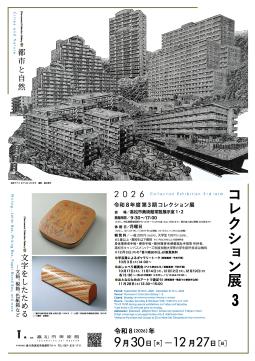
Gallery 1:Cities and Nature
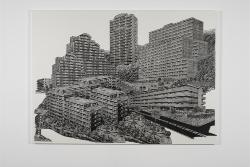
Sachiko Kazama《Babel》2019 photo:kenji Morita
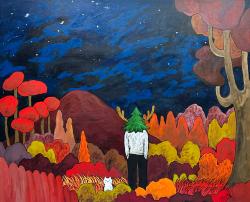
Yuichi Hirako《Lost in Thought 246》2026 ⒸYuichi Hirako
The work of HIRAKO Yuichi was added to the museum’s collection last year. He is an artist who seeks to explore the boundaries between nature and humanity in contemporary society. His work stems from a sense of dissonance in the fact that the term “nature” is often used even for plants under human control, such as houseplants, street trees, and plants in parks. In this third Collection Exhibition, and taking Hirako’s sense of unease as a starting point, we will examine the boundaries between nature and humanity through the broadly defined concepts of “nature” and “city.”
KAZAMA Sachiko created her pieces by transforming the eerie imagery she sensed in promotional renderings for apartment buildings, one symbol of a modern city. In her woodblock prints, this imagery is overlaid with the story of the Tower of Babel from Genesis, with the tower continuing to reach toward the heavens even as its collapse is inevitably foreseen. Furthermore, in the abstract sculptures of SHINODA Morio, inspired by the Italian cliff-top medieval fortified city of Calcata, all traces of “nature” are eliminated, leaving the pieces imbued with a sense of tension and solidity.
YANAGI Yukinori addresses the issue of the individual and the nation by depicting nature, in the form of ants, moving freely across borders as national flags crumble. TERUYA Yuken uses toilet paper rolls, a wood-based everyday item, to recreate a pristine-looking forest while critiquing capitalist society. Friedensreich Hundertwasser, who expressed early concerns about environmental issues, consistently advocated that we humans should return to nature, take nature as our model, and rediscover our true selves. Through these artists’ expressions, we can see various challenges facing us as modern people living in an urban environment today.
Furthermore, HONDA Takeshi sets up a tent around his subject when painting outdoors and takes time to render it meticulously. HASHIMOTO Masaya, drawing on his experiences from accompanying hunters, carves plant forms from deer bones and antlers. Their works convey certain ways in which modern people, standing on the boundaries, engage with nature and life.
We hope that this exhibition, featuring 14 pieces by 13 artists, will help us, as human beings who are ourselves part of nature, find clues for moving toward a better future.
Gallery 2: Writing—Letter Box, Writing Box, Paperboard Box, and more
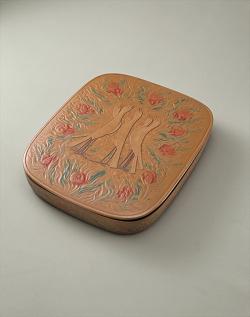
Joshin Isoi《Writing Box with Birds Singing in Chorus Design, Choshitsu》1954 photo:Akira Takahashi
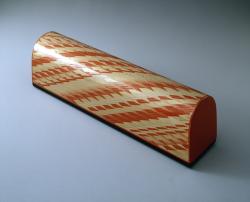
Shoji Tuji《Strip of Paper Box,Makie, Kanshitsu》1993 photo:Akira Takahash
Paper, invented in China during the Western Han Dynasty (202 BCE–8 CE), was introduced to Japan in 610 CE during the reign of Empress Suiko by the Goguryeo monk DONCHO. The extremely precious paper was used to write waka poems, stories, letters, and other texts, which were then stored in boxes decorated in various ways according to their intended use. Alongside paper, inkstones, ink, and brushes have also been long cherished as the “Four Treasures of the Study.”
In this third Collection Exhibition, we focus on the forms of boxes traditionally used to store writing implements and introduce them in five categories: Letter Box and Writing-paper Box, Writing Box, Writing-brush Box, Paperboard Box, and Strip of Paper Box.
In the Letter Box and Writing-paper Box section, we present a variety of boxes designed to store books, writing paper, and letters. The exhibition begins with letter Box, Kinma, a representative specialty product of the Meiji period by TAMAKAJI Setsudo, the third son of TAMAKAJI Zokoku, regarded as the founder of Sanuki lacquerware. Also on display is Writing-Paper Box with a Pair of Catfish Design, Choshitsu, a richly decorated work by OTOMARU Kodo, who was the first artist to be designated a Holder of an Important Intangible Cultural Property for Choshitsu. In the Writing Box and Writing-brush Box sections, you will be drawn to the delicate beauty of the “acacia” motif shared by the writing brush box by ISOI Joshin, a holder of Important Intangible Cultural Property (Living National Treasure) for Kinma, and the writing box by OTA Katsuko, his daughter-in-law and pupil. The Paperboard Box section features flat boxes for storing paperboard, including magnificent works by KAGAWA Soseki employing “Zonsei,” one of the three techniques of Sanukishitsugei (Sanuki Lacquerware) developed by Zokoku, as well as works by OTA Hitoshi, who revived the “Rantai” technique, in which bamboo is woven into a lattice to form a base, for the modern era. Finally, the Strip of Paper Box section presents rectangular boxes for storing short strips of paper that demonstrate the rich expressiveness of Sanukishitsugei (Sanuki Lacquerware), making full use of techniques such as “Tsuishitsu,” “Kanshitsu,” and “Makie.”
Through 28 works by 20 lacquer artists, enjoy the variety of boxes related to writing that have emerged over the past century.
Information
Period:
September 30.(Wed),2026-December 27(Sun.),2026
Venue:
Permanent Collection Gallery
Closed:
Monday (the following weekday if Monday is a holiday)
Hours:
Monday-Saturday & Holidays: 9:30-17:00 (Entry until 16:30)
*Until 19:00 during special exhibitions on Friday and Saturday.
*Last entry is 30 minutes prior to closing.
Organized by:
TAKAMATSU ART MUSEUM
Admission:
【General 】200yen(160yen)
【University students】150yen (120yen)
【High school age or younger/Seniors 65+】Admission free
※Advance Purchase and Groups of 20 or More Get Discounts (pricing in parenthesis)
※Free admission for those with a physical disability certificate, rehabilitation certificate, or mental disability certificate.
Telephone Inquiry
TAKAMATSU ART MUSEUM
TEL +81-87-823-1711
高松市美術館SNS
美術館の裏側やワークショップなど関連イベントのレポートなど、高松市美術館情報を配信しています。
PDF形式のファイルを開くには、Adobe Acrobat Reader DC(旧Adobe Reader)が必要です。
お持ちでない方は、Adobe社から無償でダウンロードできます。
 Adobe Acrobat Reader DCのダウンロードへ