Collection Exhibition 1st term 2026
PERMANENT
April 4(Sat.),2026-June 28(Sun.),2026
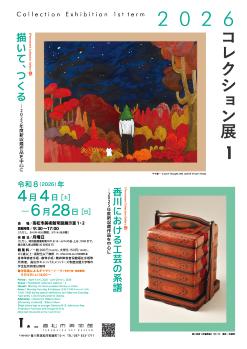
Gallery 1:Drawing and Creating - primarily features the new collection acquired in FY 2025
The Takamatsu Art Museum systematically collects works based on three core areas: “Postwar Japanese Contemporary Art”, “Art in the 20th Century and Beyond in the World”, and “Arts and Crafts of Kagawa”. The museum’s collection now comprises approximately 1,800 works.
Under the theme “Drawing and Creating,” this exhibition introduces 24 works by 8 artists, focusing on new acquisitions from fiscal year 2025.
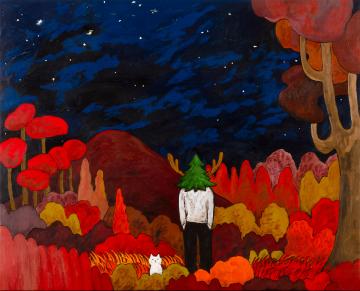
In Hirako Yuichi’s Lost in Thought 246 (2026, new acquisition), a familiar character from his works—a figure with a tree-shaped head—stands quietly in a forest beside a white cat. In this painting, which represents the foundation of Hirako’s practice (he now also works in installation and sculpture), his distinctive use of color and his characteristic forms of trees, mountains, and human figures are especially striking.
The paintings by Oki Hiroyuki —who is a video artist and passed away suddenly in October 2025—feature lines and text such as place names and personal names drawn in an apparently random manner, which at times coalesce into mountain-like shapes or landscapes. These works seem to trace the pathways of Oki’s thoughts as he created films while traveling from place to place.
Konoike Tomoko’s Wolf Bench (2026, new acquisition, on view in the entrance hall) is a resin bench in the form of two wolves, decorated with seasonal plants and landscapes. As its name suggests, the work is fully functional: visitors may sit on the bench and appreciate the painted imagery up close, enveloped by the wolves’ forms.
We also present a special display of works by Ueda Kaoru, who passed away in September 2025, including four paintings donated last year alongside works from the museum’s collection. These include Pencil (ca. 1972, new acquisition), an early work executed in Superrealist style; Raw Egg J (1978), which captures the moment an egg cracks and its contents spill; and Flow T (1997, new acquisition), depicting flowing water across a divided canvas. Although Ueda’s paintings are often described as “photographic,” a closer look reveals visible brushstrokes and a strong sense of materiality inherent to painting.
We hope you enjoy the diverse expressions that emerge from each artist’s distinctive lines and color choices.
Gallery 2:The Genealogy of Crafts in Kagawa - primarily features the new collection acquired in FY 2025
Kagawa has long been known for its lacquerware and metal work, and has produced many distinguished artists over the years. The Takamatsu Art Museum has made Arts and Crafts of Kagawa (Lacquerware and Metalwork) one of its key collection areas and now holds more than 600 craft works. This exhibition presents the lineage of Kagawa’s craft traditions, focusing on four lacquerware works and two metalwork pieces newly added to the collection in fiscal year 2025.
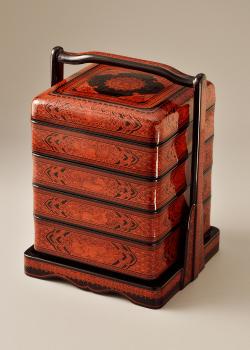
Sanuki lacquerware traces its origins to the Edo period, when the lacquer artisan Tamakaji Zokoku served the Takamatsu Domain. Confectionery Container, Kinma (1861, new acquisition) by Fujikawa Kokusai—Zokoku’s younger brother, who assisted in the family scabbard-lacquering business and studied lacquer techniques—features auspicious motifs rendered entirely in kinma, one of the three principal techniques of Sanuki lacquerware. This four-tiered portable box demonstrates Kokusai’s exceptional craftsmanship.
The artist of Writing-paper Tray and Writing Box, Kinma (date unknown, new acquisition), Fujikawa Ransai, was Kokusai’s son. This work, created using kinma on a wicker base—a material frequently employed in Sanuki lacquerware—illustrates how lacquer techniques were transmitted across generations. This lineage continues today. In Bowl, ‘Shady Pass,’ Kinma (1998, new acquisition) by Yamashita Yoshito, designated a Holder of Important Intangible Cultural Property in 2013, a path lined with blooming mountain hydrangeas is expressed through masterful use of the kinma technique.
Incense Burner with Gozan (Five Important Temples) Design, Gilt Gold (date unknown, new acquisition) by Kitahara Senroku —who studied at the Kagawa Prefectural Kogei School (now Kagawa Prefectural Takamatsu Kogei High School) and later graduated from the Metalwork Department of the Tokyo Fine Arts School (now Tokyo University of the Arts)—employs a traditional Chinese motif while incorporating a modern sensibility characteristic of Kitahara in the design of the lid.
In Two Deer (date unknown, new acquisition), a relief by Osuga Takashi, a student of Kitahara, a pair of deer is framed within a circular wreath of broad-leaved trees. Both the subject matter and the technique reflect his teacher’s influence.
Through 39 works by 20 artists, the exhibition highlights the refined techniques and innovative designs that characterize Kagawa’s craft traditions, offering an overview of a heritage that has been passed down through generations.
Information
Period:
April 4(Sat.),2026-June 28(Sun.),2026
Venue:
Permanent Collection Gallery
Closed:
Monday(except. May 5), May 7
Hours:
Monday - Saturday & Holidays: 9:30 - 17:00 (Entry until 16:30)
*Until 19:00 during special exhibitions in Friday and Saturday.
*Last entry is 30 minutes prior to closing.
Admission:
【General 】200yen(160yen)
【University students】150yen (120yen)
【High school age or younger/ Seniors 65+】Admission free
※Advance Purchase and Groups of 20 or More Get Discounts (pricing in parentheses)
※Free admission for those with a physical disability certificate, rehabilitation certificate, or mental disability certificate.
Organizer:
Takamatsu Art Museum
Telephone Inquiry
Takamatsu Art Museum
TEL +81-87-823-1711
PDF形式のファイルを開くには、Adobe Acrobat Reader DC(旧Adobe Reader)が必要です。
お持ちでない方は、Adobe社から無償でダウンロードできます。
 Adobe Acrobat Reader DCのダウンロードへ