Collection Exhibition 4th term 2025
PERMANENT
Gallery 1: "ART" for the Future: The Kagawa Postwar Art Scene and the Rise of the Takamatsu Art Museum
[Gallery1]January 6 (Tue.), 2026-March 11 (Wed.), 2026
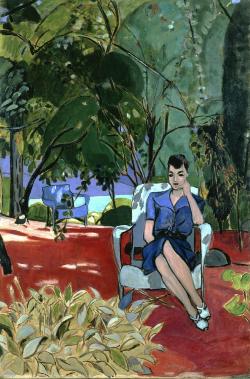
Inokuma Genichiro《In the Shade of the Tree》1946 ⒸThe MIMOCA Foundation
In recent years, Kagawa has found many ways to stake an appealing claim in the world of art using our local art resources, including many wonderful modern buildings, characteristic museums, and the Setouchi Triennale held for the sixth time last year.
One of the sources of this outpouring of art in Kagawa can be traced to the opening in 1949 of the Takamatsu Bijutsukan, which would later become the Takamatsu Art Museum. The lacquer artist Akashi Bokkei (1911-1992), who returned to Takamatsu the year after World War II ended, was shocked to find the burnt-out plains, with only the Ritsurin Garden remaining as the only forested area, and in that moment saw the determination to create a museum. This was the beginning of the project to bring a museum to Takamatsu. Other local artists joined with Akashi, such as Kitahara Senroku (1887-1951), a metalwork artist who evacuated to his hometown of Takamatsu during the war, and Isoi Joshin (1883-1964), a lacquer artist who founded Daido Kogei-sha (the company Daido Kogei) to aid other returned artists. This core group formed Kagawa-ken Bijutsu Kyokai (the Kagawa Art Committee), with five divisions—Japanese painting, oil painting, craftwork, sculpture, and calligraphy—to support the museum plan. Furthermore, sympathetic city council members who eagerly supported the artists’ aspirations, and on November 3, 1949, the Takamatsu Bijutsukan opened on the grounds of the scenic Ritsurin Garden as a public museum from the early postwar era. The prominent modernist architect Yamaguchi Bunzo (1902-1978), through the introduction of the then Tokyo-based painter Inokuma Genichiro (1902-1993), designed a white, modern building with an emphasis on straight lines that held a fresh appeal at the time.
This exhibition features 35 works and materials from 14 artists, looking back over the ties between the art scene in postwar Kagawa and the Takamatsu Art Museum. Central to the exhibition are the postwar activities of Inokuma Genichiro, who crossed to Europe before the war, Kashiwabara Kakutaro (1901-1977), alongside the post-war craftwork of Akashi Bokkei and others. A special screening presents "Mu"(2003-2011), filmed in Tokyo, Kagawa, and China by Oki Hiroyuki (1964-2025), who is a video artist with strong ties to Kagawa, and passed away suddenly in 2025.
Gallery 2: The Beauty of Sanuki Lacquerware
[Gallery2]January 6 (Tue.), 2026-March 29 (Sun.), 2026
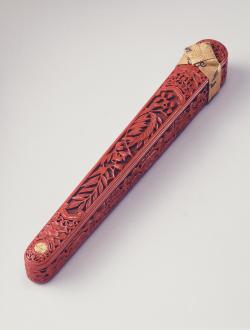
Tamakaji Zokoku《Hichiriki Case with Deutzia and Peony Design, Thuishu》1851 Photo by Takahashi Akira
Credit for the prosperity of Sanuki lacquerware art, a representative of traditional industries in Kagawa prefecture, goes to Tamakaji Zokoku (1806-1869), who thrived in the late Edo era. Zokoku accomplished his own remarkably diverse lacquerware style, drawing inspirations from Zonsei and Choshitsu from China, as well as Rantai Kinma from Southeast Asia. Kinma, Choshitsu, and Zonsei are now collectively known as "the three techniques of Kagawa lacquerware."
After Zokoku’s death, his brother, Fujikawa Kokusai (1808-1885), continued his brother’s techniques, introducing Kinma and Zonsei lacquerware to all of Japan. However, the overproduction of crude products by some in the lacquerware industry eroded public confidence, and Zonsei and Kinma had gradually faded away by the end of the Meiji era. A new mainstream in the industry replaced them—Sanuki carving, a technique that involves applying colored lacquer to wooden carvings. The shop that sold such products, called "Hyakkaen," and the surrounding area would produce master carvers such as Ishii Keido (1877-1944) and Kamada Kado (1896-1957), all of whom left behind masterpieces of the art.
There were further developments in 1927 when the Imperial Exhibition added a faculty of Crafts. Skilled masters of craft and form, such as Isoi Joshin (1883-1964) and Otomaru Kodo (1898-1997), unveiled works overflowing with modern sensibilities. Joshin further honed his skills by studying the work of Zokoku and Kokusai, and he proposed "ten-bori (dot carving)" drawings inspired by printed matter in 1913. Otomaru Kodo, who had relocated to Tokyo, introduced a more colorful mode of expression by using lake pigments—developed in the early Showa era —to produce intermediate hues and vividly colored lacquer.
When the system of Important Intangible Cultural Property (Living National Treasures) was implemented in 1955, Otomaru Kodo was appointed for Choshitsu, and Isoi Joshin for Kinma in the following year. This was followed by the appointment of Isoi Masami (1926-2023), Ota Hitoshi (1931-2019), Yamashita Yoshito (1951-), and Otani Hayato (1954-) as Important Intangible Cultural Property for establishing Kinma's rich colors and diverse range of expression. In 1962, Kagawa Soseki (1891-1976) was also appointed the holder of the Kagawa Prefecture Designated Intangible Cultural Asset Holder for Zonsei.
Information
Period:
[Gallery1]
January 6 (Tue.), 2026-March 11 (Wed.), 2026
[Gallery2]
January 6 (Tue.), 2026-March 29 (Sun.), 2026
Venue:
Permanent Collection Gallery1・2
Closed:
Monday (the following weekday if Monday is a holiday), March 12 and March 13
Hours:
Monday-Saturday & Holidays: 9:30-17:00 (Entry until 16:30)
*Until 19:00 during special exhibitions on Friday and Saturday.
*Last entry is 30 minutes prior to closing.
Admission:
【General 】200yen(160yen)
【University students】150yen (120yen)
【High school age or younger/Seniors 65+】Admission free
※Advance Purchase and Groups of 20 or More Get Discounts (pricing in parenthesis)
Organizer:
Takamatsu Art Museum
Telephone Inquiry
Takamatsu Art Museum
TEL +81-87-823-1711
PDF形式のファイルを開くには、Adobe Acrobat Reader DC(旧Adobe Reader)が必要です。
お持ちでない方は、Adobe社から無償でダウンロードできます。
 Adobe Acrobat Reader DCのダウンロードへ